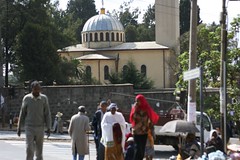
Here is a brief column by the monthly publication, Whats Up Addis! Its not exactly the Metropolitan Spirit, but its one of the only free publications thats easy to find around town. Enjoy this months' feature with some additional commentary, free of charge.
Markato : Said to be the largest open-air market in Africa, it's a great place to wander around and find anything you can think of. From electronics to spices, clothes to automobile spare-parts... this crowded, bustling and colourful part of town is the place to go! Particularly if you are interested in intimate mixing with the donkeys, goats, and ceaseless traffic.
Blue Taxi : The infamous blue taxis of Addis! This city would not be the same without them. Transporting most of the city's population and giving all the rest heart attacks and ulcers, blue taxis are as much a part of Addis as fish are a part of the sea. Well said.
Beggars : A sad sight around the streets of Addis is the thousands of beggars with no means of support. Hundreds flock to the city in hopes of jobs and a better future, but many of them unfortunately end up on the streets. A great way to help beggars is to hand out meal tickets. Hope Enterprises sells tickets which entitle the holder to a meal. This way someone gets fed and you know the money isn't being misused! Or if you need a packet of tissue for some reason, say after an unlucky visit to a restaurant, you can get them for 1 birr from about every kid on the street.
Religious ceremonies : Ethiopia is a country with a very rich religious heritage. Every year the streets of Addis are home to colourful religious events, the most colourful being Timket in January with processions that are a delight to watch, Meskel in September with a huge Demera at Meskel Square and Ramadan with everyone celebrating together. Come to Africa to escape the incessant sound-systems blasting from SUVs? Thankfully, the religious institutions here pick up the slack by constantly blaring chants, amharic hallelujahs & amens all at top decibel for every neighborhood to hear all hours of the day. Again, free of charge.
Listros : What would life in Addis Ababa be if one did not stop by a friendly and hard-working Listro to polish a pair of shoes? How would one dare to show up at office with shoes dirty with the stubborn Addis Ababa kremt chiqa and bega abuara? How about a friendly chat with these hard working kids as you get your shoes nice and shiny! If folks have shoes at all, they are full leather, and they are all about getting them polished, constantly.
White traditional cloth : Ethiopian women traditionally wear white dresses, while men wear white tunics over riding pants. The ladies' shawl, the natella, usually has a very colourful border on it, which is also found near the bottom edge of the women's dress. However, a wide variety of traditional clothing can be seen in Ethiopia ranging from loin cloths to the latest fashion. Shiro Meda is a great place to shop for these elegant accessories.
Coffee : Coffee is one of the country's strongest symbols. Ethiopia thrives on coffee and likes to drink it too. Once you have tasted Ethiopian coffee, there is no going back - there is nothing else like it! Addis has cafes on every street serving great 'buna'. For those who have time and want to have the real Ethiopian experience, the coffee ceremony is not to be missed--be prepared though, you are in it for three
delicious cups! One would think, considering Addis as father to coffee, that a good cup of joe would be standard issue at Bingham. Wrong. In fact, its weak, tasteless. Some even swear its instant coffee, gasp.
Injera : Teff is the staple grain of Ethiopia. The grain yields a seed much smaller than the size of a wheat grain, but is the basis of Ethiopian traditional. As it turns out, dont serve someone injera until its three days old. If its fresh off the griddle, its an insult to your guests.
Addis Ababa has a great number of restaurants that serve injera and all the tasty wots that go with it. Treat yourself to some wonderful cuisine and most traditional restaurants feature live singing and dancing to keep your eyes and ears happy as well as your taste buds! Never fear, your gastrointestinal will be fine. All the restaurants here are clean, safe, sanitary, and gladly welcome all ferengi patrons.
See more at www.whatsupaddis.com
DC